Z-Wave Summit 2024 – Austin TX

The Z-Wave Summit & UnPlugFest took place last week in Austin TX. If you missed it, here is a quick Recap. I organized the UnPlugFest on Tuesday which included an RF Range test down the Colorado River right in downtown Austin. The Z-Wave Alliance Reference Application Design (ZRAD) won the maximum range with a distance of 1.1miles (1.7km) which wasn’t quite line-of-sight (LOS). I produced a video of the event which you have to be a member of the Alliance to gain access. Virtually all of the other Z-Wave Long Range Devices tied in a close second place at 0.7mi (1.1km) however we had limited LOS points to test at bridges across the river. We proved that PCB antennas and shipping Z-Wave devices in a noisy RF environment can easily achieve over a kilometer of range. Note that we measured the range where we are getting 100% corruption free, fully encrypted packets at 100kbps. Obviously we could go much farther if we are just trying to get a NOP to ACK but that’s not useful even though other protocols use that as their yardstick.

The Open Source Work Group met in-person in the afternoon to work on finalizing User Code Command Class. Additional Range testing was measured inside the hotel (with concrete floors) where most devices were able to pass thru several floors. Late in the afternoon was the Fireside Chat where we aired our hope, desires and disappointments for Z-Wave. Watch for a survey coming out soon!

Tuesday evening is the network event which was hosted by Silicon Labs where all the Z-Wave personalities meet and renew friendships and business relationships.

My presentation on the Z-Wave Alliance (ZWA) Reference Application Design (ZRAD) is a preview of the soon to be released github project. There were lots of presentations on all sorts of IoT related topics. You can find the presentation on the ZWA members web site.

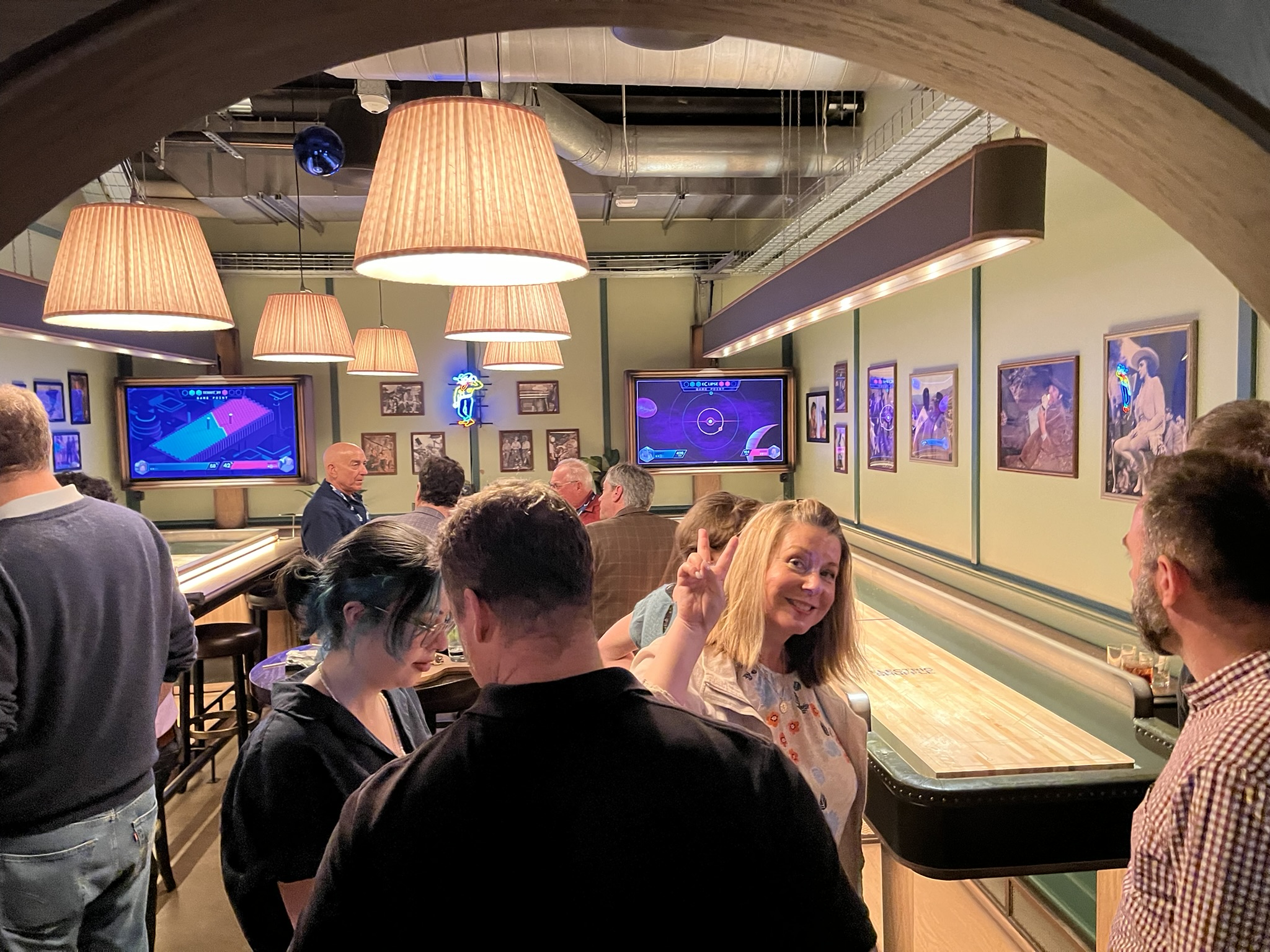
FUN! Electric Shuffle

After the UnPlugFest and a full day of presentations it was time to relax and join the competition at Electric Shuffle.
Summit Takeaways

This is my personal set of takeaways. Please add yours in the comments below!

  • Z-Wave is very much alive!
    • Lots of new products have been certified and more are in the pipeline
    • Most are Z-Wave Long Range
  • Z-Wave spec and Open Source Code continues to improve
  • Z-Wave Long Range is indeed Long Range!
    • Over 1mi LOS in downtown Austin – over 2mi proven in NH
  • Certification for an SDK Update is Review ONLY!
    • No need to redo the entire certification process to update the Z-Wave SDK
    • Previously a full re-cert was required ($$$!)
    • Now you can get the latest bug fixes/security patches and just file paperwork for cheap
  • Can add Z-Wave Long Range (ZWLR) to a device and keep the same FCCID
    • Can OTA devices already in the field to add ZWLR!
    • Requires working with the “right” FCC test house and FCC must be redone with the new frequencies
    • Talk to Trident for more details
  • Why is the RF range so short in the EU for many devices?
    • 500 series devices can only transmit at -1dBm (hardware limitation)
    • 700/800 can transmit at +14! More than twice the range!
    • Update those EU devices!
  • USB Zniffer firmware can capture BOTH ZWLR frequencies
    • Select US_LR_END_DEVICE for the region to get ONLY the 2 ZWLR channels (no mesh channels)
    • Select US_LR_BACKUP to get the ZWLR B channel and mesh channels
    • Select US_LR to get ZWLR A channel and mesh channels
  • Z/IP Gateway has a maintenance release expected in June but there will probably only be 1 more maintenance release before it EOLs
    • Switch to Unify or Z-Wave JS soon!

Z-Wave Summit 2017 at Jasco in Oklahoma City

“IoT Device Testing Best Practices” by Eric Ryherd

Summit1Click HERE to see the entire presentation including my notes. If you are a Z-Wave Alliance member a video of the presentation is usually posted on the members only section of their web site. The main takeaways from my presentation are:

  • Have a written test plan
  • Use the Compliance Test Tool (CTT) as the START of your test plan
  • Vary the environmental conditions during testing
  • Test using real world applications
  • Test using complex Z-Wave networks with routing and marginal RF links
  • Test with other hubs and devices
  • Automate testing using tools like the ZWP500
  • Code firmware with failure in mind
  • Utilize the WatchDog timer built into the Z-Wave chip

ZWaveSummit2017aThe presentation goes into detail on each of these topics so I won’t duplicate the information here. I also go thru several failures of devices I’ve been working with. You learn more from failures than you do when everything just works. Feel free to comment and let me know what topic you’d like to see for next years summit.
Z-Wave Summit Notes

One of the main purposes of the summit is to learn what’s new in Z-Wave and what Sigma is planning for the future. The most important news at this year’s summit is SmartStart. The goal for SmartStart is to simplify the user experience of installing a new device on a Z-Wave network. The concept is that a customer will open the package for a device, plug it in, the hub is already waiting for the device to be joined and the device just shows up on their phone without having to press a button or enter the 5 digit pin code. This is a “game changer” as Sigma pointed out many times during the summit. Typically a user has to put their hub into inclusion mode, read the product manual to determine the proper button press sequence to put the device into inclusion mode, wait for the inclusion to go thru, write down the NodeID number, with an S2 device they have to read the teeny-tiny 5 digit PIN code printed on the product (or scan the QR code) and then MAYBE the device is properly included. Or more often, they have to exclude and retry the process all over again a couple of times. SmartStart as you can see will make the user experience much easier to get started with Z-Wave.

SmartStart enables “pre-kitting” where a customer buys a hub and several devices as a kit. The hub and the devices in the kit are all scanned at the distribution warehouse and are all white listed on the hub web site. When the customer plugs all the devices in, they automatically join and all just magically show up ready to be used without the frustration of trying to get all the devices connected together. Unfortunately there are no devices that support SmartStart and there are no hubs that support it either – yet. We’ll get over that eventually but I suspect it’ll take a year before any significant numbers of SmartStart supported devices show up on Amazon.

SmartStart is enabled in the SDK release 6.81 which occurred during the summit. There are some other handy features in this release. The main new feature (after SmartStart) is the ability to send a multi-cast FLiR beam. One problem with FLiR devices is that they are all sleeping devices and briefly wake up once per second to see if someone wants to talk to them. Prior to 6.81 you had to wake up the devices one at a time and each one would take more than one second to wake up. If you have battery powered window shades like I do, there is a noticeable delay as the shades start moving one at a time instead of all together. Both the shades and the remote (or hub) will need to be upgraded to 6.81 before we can use this new feature. That means it’ll be again probably another year before this feature is widely available, but it’ll get there eventually.

There are rumors that Sigma will be announcing a new generation of the Z-Wave transceiver chip in early 2018. I am hoping it will will finally include the upgrade from an 8-bit 8051 CPU to a more capable 32-bit ARM CPU.  The current 500 series relies on the ancient 8051 with very limited debugging capabilities which significantly slows firmware development. With an ARM CPU developers like Express Controls will find it easier to hire engineers who can code and debug firmware and thus we’ll be able to bring more Z-Wave products to market in less time.

A new web site, Z-WavePublic.com, has been populated with the Z-Wave documentation as well as images for the Beagle Bone Black and Raspberry Pi loaded with Sigmas Z/IP and Z-Ware. With one of these boards and a USB Z-Stick anyone can start developing with Z-Wave without having to sign a license agreement. Nice way to get started with Z-Wave for you DIY nerds out there. There were many other presentations on Security S2, Certification, The CIT, Z/IP, HomeKit and many other topics on the technical track of the summit. The marketing track had a different set of presentations so I recommend sending both a technical person and a marketing person to the summit.

Summit isn’t all work, work, work

IMG_20170927_090355The Summit isn’t all work all day though the days are long and tiring. Tuesday evening was a reception at Coles Garden which is a beautiful event venue. Unfortunately it was raining so we couldn’t wander thru the gardens much but Mitch, the Alliance Chairman, kept us entertained.

Wednesday evening was the Members Night at the Cowboy museum. Oil profits made a lot of wealthy Oklahomans who were able to make sizable donations to this huge museum. There is a lot more to see than we had time to explore so I’d recommend spending more time here if anyone is visiting Oklahoma City. Lots of food and drink made for an ideal networking environment with your fellow Z-Wave developers.